


Articles
Thesis
Review
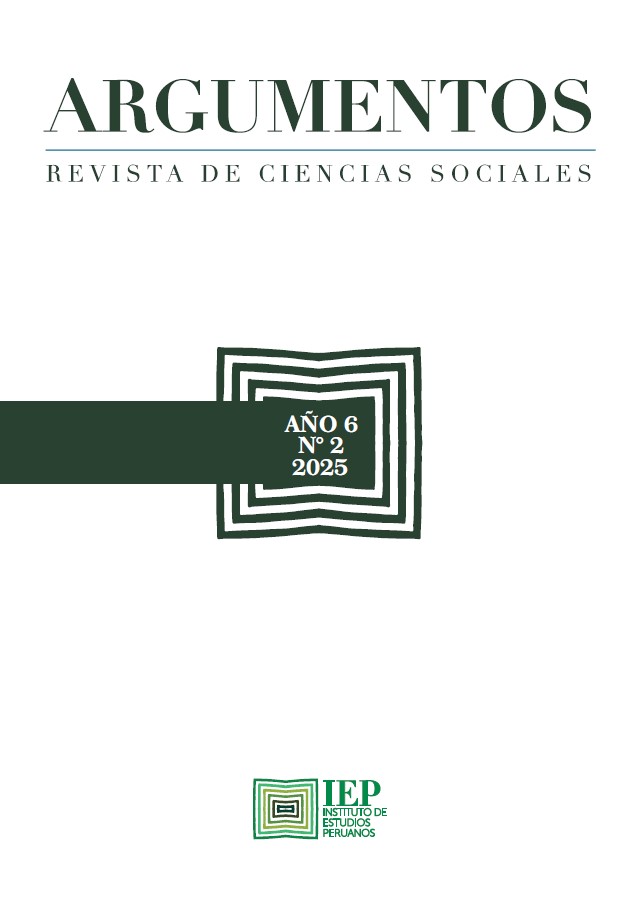
Argumentos is an academic journal in the social sciences published by the Instituto de Estudios Peruanos (IEP). Its mission is to disseminate original research that contributes to critical analysis and scholarly debate on issues related to Peru and Latin America. The journal is aimed at the academic community and is published in open access, with a semiannual frequency and a double-blind peer review process.
Argumentos does not charge any submission, processing, or publication fees to authors, nor does it charge users for access to its contents.
Open Access and Copyright Policies
Argumentos is an open-access journal that adopts a Creative Commons license. Users are permitted to read, download, copy, distribute, print, search, or link to the full texts of articles, to crawl them for indexing purposes, to pass them as data to software, or to use them for any other lawful purpose.
Authors who publish in Argumentos retain the copyright to their articles without restrictions. At the same time, authors grant Argumentos the right of first publication of the articles submitted to the journal.
Finally, it is important to clarify that the views expressed by the authors in each article do not reflect the institutional position or opinions of the Instituto de Estudios Peruanos.


Este obra está bajo una licencia de Creative Commons Reconocimiento 4.0 Internacional.
Argumentos - ISSN 2076-7722
Instituto de Estudios Peruanos - IEP
Horacio Urteaga 694, Jesús María, Lima, Perú
Central Telefónica: (51-1) 200-8500
Biblioteca: (51-1) 200-8504
Librería: (51-1) 200-8501
Arnaldo Márquez 2277, Jesús María, Lima, Perú
contacto@iep.org.pe